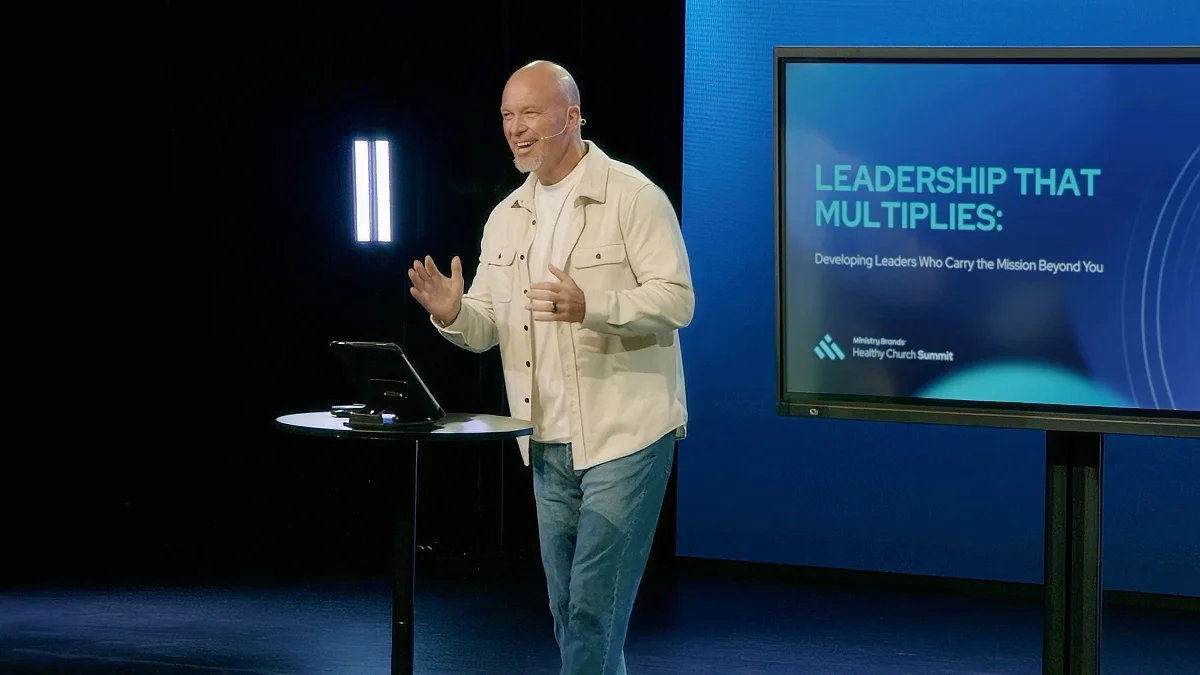
Healthy churches don’t grow stronger simply by finding more people willing to fill positions. They grow stronger when leaders intentionally invest in other people and help them become leaders too.
That was one of the central ideas Mac Lake shared during the Fall 2026 Healthy Church Summit, a free online event from Ministry Brands designed to help church leaders build healthier ministries, stronger teams, and renewed momentum.
During his keynote, Leadership That Multiplies: Developing Leaders Who Carry the Mission Beyond You, Mac challenged church leaders to rethink the way they identify, develop, and release new leaders. His message was especially timely for churches that feel like they are constantly searching for the next person who is “ready” to lead, because one of his biggest challenges was to stop depending only on ready-made leaders and start intentionally developing them.
Meet Mac Lake
Mac Lake is an author and leadership development expert who equips leaders and organizations with actionable strategies to multiply their leadership impact. Whether helping individuals lead themselves to maximize their influence, empowering teams to become healthier and higher-performing, or helping organizations scale through intentional leadership development, Mac has spent decades helping leaders multiply.
In 1997, Mac founded Carolina Forest Community Church in Myrtle Beach, South Carolina. He later transitioned to Seacoast Church in Charleston, where he served as Leadership Development Pastor and played an important role in the church’s efforts to grow and sustain healthy leadership across multiple campuses.
In 2010, Mac co-founded the LAUNCH Network in Atlanta, Georgia, which was later adopted by the North American Mission Board. Through LAUNCH, Mac helped implement leadership systems in 32 strategic cities across North America. Then, in 2019, he founded Multiply Group, a consulting company focused on helping leaders and organizations build and implement strategies to multiply healthy leaders.
Mac is also the author of ten books, including The Multiplication Effect, Super Multiplier, and The Discipling Leaders Series. At the Healthy Church Summit, he drew from that experience to answer a question almost every church eventually faces: How do we develop more leaders instead of simply hoping they show up?
Leadership Placement Is Not Leadership Development
One of Mac’s strongest challenges came early in the session. When churches need another leader, it can be tempting to look around the room, identify someone who already appears ready, and put that person into a leadership position.
But as Mac pointed out, “That is leadership placement, not leadership development.” Finding someone who is already capable of leading may solve an immediate problem, but it does not necessarily create a culture where new leaders are continually being developed.
He went on to describe several common approaches churches use when trying to prepare leaders. Sometimes a new leader shadows someone for a couple of weeks and mostly learns the mechanics of the role. Sometimes every leader in the church receives the same training regardless of their experience level. Other times, someone is simply handed responsibility and expected to figure leadership out along the way.
Those approaches may help someone complete a task or learn a system, but Mac’s point was that true leadership development has to go deeper. If churches want to multiply leaders, they have to become more intentional about helping people grow into leadership over time.
1. See the Potential in People
Mac’s first step for developing leaders is simple: see their potential.
Using Jesus’ relationship with Peter as an example, Mac explained that effective leadership development begins when someone sees more in a person than that person may currently see in themselves. Jesus didn’t only look at who Peter was in the moment. He saw who Peter could become and called that potential out of him.
That changes the question church leaders ask. Instead of only asking, “Who is ready right now?” leaders can begin asking, “Who could become ready if someone invested in them?”
Mac summarized the problem this way: “We’re so busy looking for readiness that we miss willingness.” Rather than searching only for polished leaders, he encouraged churches to notice people who are hungry to grow, demonstrate integrity, show passion, and consistently show up.
Sometimes leadership development starts with something as simple as telling someone, “I see something in you.” That kind of encouragement can help a person recognize potential they may not have seen in themselves and can open the door to a deeper development relationship.
2. Development Requires More Than Information
Churches certainly need training, but Mac also warned that information alone does not automatically create transformation.
He shared a story about attending a church planting boot camp before starting his own church. After two full days of lectures, he went home with pages of notes but still didn’t feel like he knew how to plant a church. The lesson he learned was simple: “Dumping information doesn’t produce transformation.”
Leadership development becomes much more powerful when people have opportunities to learn, practice, and process what they experienced. Mac pointed to the way Jesus developed His disciples as a model for this. He taught them important principles, gave them opportunities to practice what they were learning, and then talked through those experiences with them.
Mac described this as a rhythm of helping leaders think, try, and talk. A developing leader needs useful content and instruction, but they also need real opportunities to lead. Then, after they try something, they need someone who can help them process what happened, celebrate what went well, and identify where they can continue growing.
Mac shared an example of using this approach with a developing small group leader. They would discuss a particular leadership competency, the new leader would watch or practice it in a real ministry environment, and then they would debrief the experience together. Over time, that person became prepared to lead his own group. Even better, he eventually began developing another leader using the same process.
That is where leadership development begins to multiply.
3. Eventually, You Have to Release People to Lead
Developing leaders also requires knowing when to let go.
Mac shared that leaders are rarely going to feel 100% ready before stepping into greater responsibility. In one organization, he intentionally developed several people who could eventually take over portions of his role. When the time came for him to leave, he told two of those leaders that they were about “81% ready.”
That was enough.
His point was that there are some things leaders can only learn once they are actually carrying the responsibility themselves. You can train, coach, and prepare people well, but eventually they need the opportunity to step into leadership and learn through experience.
The same principle applies inside the church. Releasing someone to lead doesn’t mean abandoning them or setting them up to fail. It means recognizing that experience is part of development and trusting them enough to give them meaningful responsibility.
The goal is not to create leaders who always need you standing beside them. The goal is to develop leaders who can eventually carry the mission beyond you.
Multiplication Changes the Future of a Church
Near the end of his session, Mac challenged churches to think bigger about leadership development.
Churches should not simply be filling volunteer openings or solving this month’s staffing challenges. They should be intentionally developing people who can disciple, influence, lead, and eventually develop others.
Mac described this as building leaders for a Kingdom legacy. When leadership development becomes intentional and reproducible, its impact can extend far beyond one ministry, one leader, or one generation.
That may begin with a surprisingly simple exercise. Mac encouraged leaders to write down the names of two people who are not currently leading but in whom they already see leadership potential.
Those names could become the starting point for a new kind of leadership culture. See their potential. Invest in their development. Give them opportunities to grow. And, when the time comes, release them to lead.
Watch Mac Lake’s Full Healthy Church Summit Session
These ideas only scratch the surface of Mac Lake’s keynote.
In the full session, Mac shares more of the leadership development framework he has used throughout his ministry, walks through the way Jesus developed His disciples, gives practical examples for developing leaders at different levels, and answers questions about helping people recognize leadership potential they may not yet see in themselves.
You can watch Leadership That Multiplies: Developing Leaders Who Carry the Mission Beyond You along with the rest of the Healthy Church Summit sessions on demand for free.
If your church wants to build stronger teams, expand its capacity, and develop leaders who can carry the mission into the future, this is a conversation worth continuing.
